
The Spider card game, commonly known as Spider Solitaire, is one of the most popular single-player card games in the world. With its distinctive multi-column layout and challenging gameplay, Spider Solitaire offers a different experience from traditional Klondike Solitaire.
But where did Spider Solitaire come from? When was it created, and how did it become one of the most recognizable digital card games?
The history of Spider Solitaire is closely connected to the long development of patience and Solitaire games. Its popularity grew significantly with the rise of personal computers, especially after Spider Solitaire became widely available as part of Microsoft Windows.
What Is Spider Solitaire?
Spider Solitaire is a single-player card game that belongs to the Solitaire family.
Unlike Klondike Solitaire, which usually uses one deck, traditional Spider Solitaire uses two standard 52-card decks, giving the game a total of 104 cards.
The objective is to arrange cards in descending sequences from King to Ace. Once a complete sequence of the same suit has been formed, it can be removed from the playing area.
The goal is to remove all cards from the tableau.
Spider Solitaire is known for requiring more planning than many simpler Solitaire variations.
Where Did Spider Solitaire Originate?
The exact origin of Spider Solitaire is not completely documented.
Like many traditional card games, Spider Solitaire appears to have developed within the broader family of patience games. These games evolved in Europe over several centuries and included numerous layouts and rule variations.
Because card games were frequently shared through books, publications, and personal instruction, it can be difficult to identify the exact person who invented a particular variation.
Spider Solitaire eventually developed its own distinctive identity through its multi-deck format and unique tableau structure.
Why Is It Called Spider Solitaire?
The reason for the name “Spider” is not completely certain.
The game has a distinctive layout with multiple columns of cards, which may have contributed to the name. Some interpretations also associate the eight foundation-building objectives with the image of a spider's eight legs.
However, the exact historical explanation for the name is unclear.
What is certain is that the name became strongly associated with this particular Solitaire variation.
The Traditional Spider Solitaire Setup
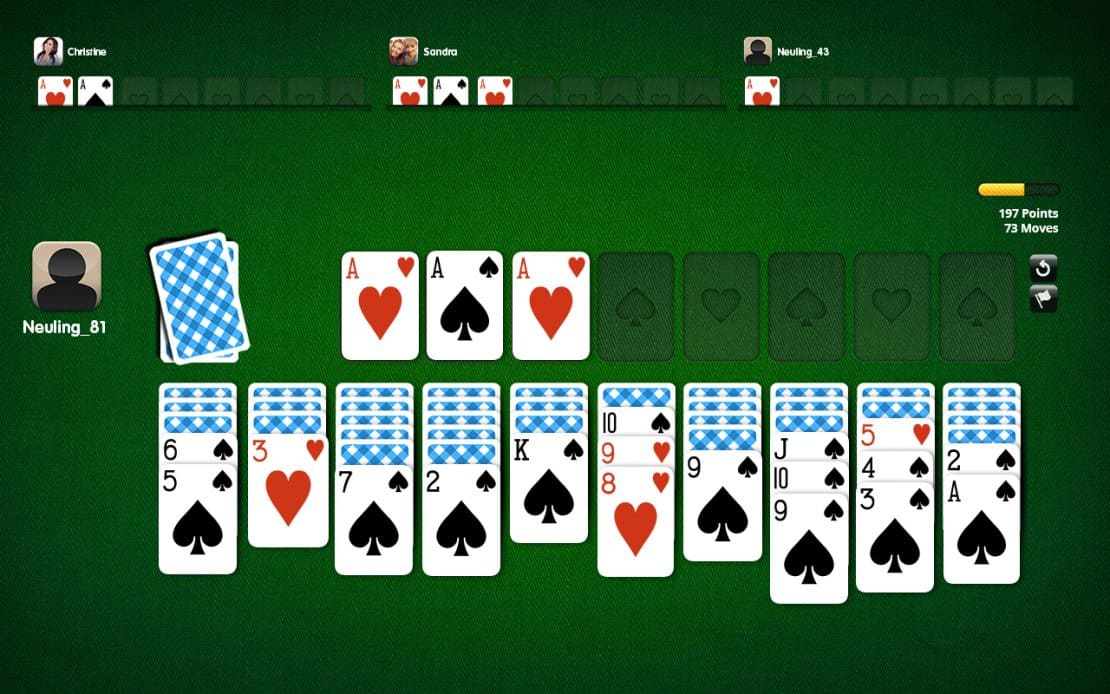
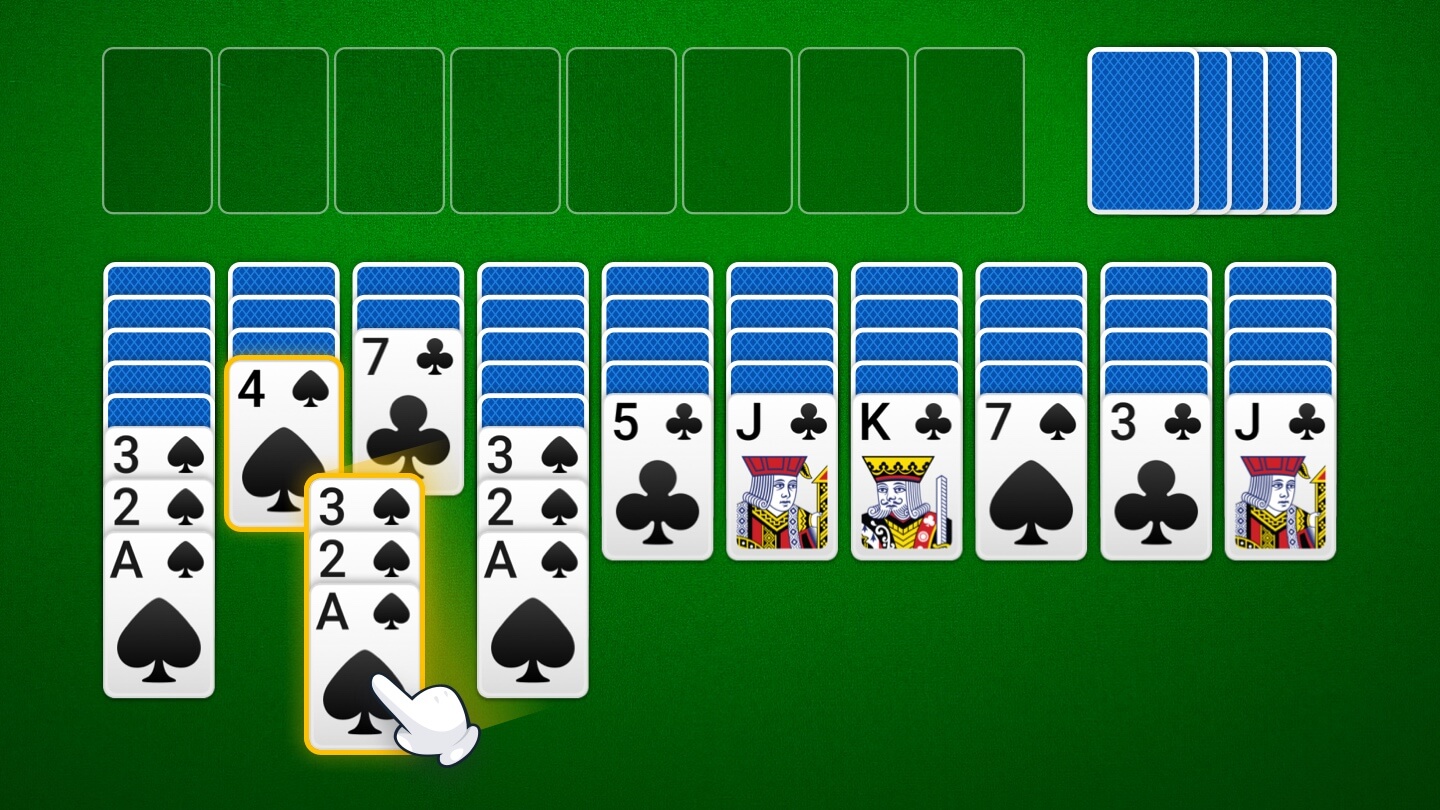
Spider Solitaire is typically played with ten tableau columns.
Cards are dealt across the columns, with some cards face down and one face-up card at the end of each column.
The remaining cards form the stock.
Players move cards between columns to create descending sequences.
For example: King → Queen → Jack → 10 → 9
The ultimate goal is to build complete sequences from King down to Ace in the same suit.
Once a complete same-suit sequence is created, it is removed from the tableau.
The Early Development of Spider Solitaire
Before becoming a popular computer game, Spider Solitaire was part of the broader world of patience-style card games.
Physical card versions required players to manually shuffle and deal two decks. This made setup more complicated than games using a single deck.
However, the game's strategic depth made it appealing to players who enjoyed challenging solo card games.
The objective was simple to understand, but completing a game successfully could require careful planning.
Why Spider Solitaire Was Challenging
Spider Solitaire developed a reputation as a challenging Solitaire game for several reasons.
Two Decks
Using 104 cards creates a much larger playing area than traditional Klondike.
Multiple Suits
In the standard four-suit version, players must carefully manage cards of different suits.
Hidden Cards
Many cards are initially face down, so players have to reveal them strategically.
Limited Moves
Poor decisions can quickly block important sequences and make the game difficult or impossible to complete.
These characteristics gave Spider Solitaire a reputation as a game that rewards patience and strategic thinking.
Spider Solitaire Enters the Computer Era
The transition from physical cards to computers was a major turning point in the history of Spider Solitaire.
A computer could handle the complicated setup automatically.
Instead of manually shuffling two decks and dealing ten columns, the software could instantly:
- Shuffle 104 cards
- Deal the tableau
- Track card positions
- Validate moves
- Automatically move completed sequences
- Record scores
- Start new games
This made Spider Solitaire much more convenient to play.
Microsoft Spider Solitaire and Its Popularity
The biggest popularity boost for Spider Solitaire came from its inclusion in later versions of Microsoft Windows.
When Spider Solitaire became available as a built-in computer game, millions of people were introduced to the variation.
This was important because many computer users had already become familiar with Klondike Solitaire. Spider Solitaire provided a more challenging alternative while still using recognizable card-game concepts.
Players could experiment with different difficulty levels and gradually improve their skills.
Spider Solitaire in Windows
Microsoft's digital version helped standardize the way many people experienced Spider Solitaire.
The game typically offered different suit options, allowing players to choose different levels of difficulty.
A common structure included:
-
One-suit Spider
-
Two-suit Spider
-
Four-suit Spider
One-Suit Spider
Using only one suit makes the game much easier because every descending sequence can potentially become a complete same-suit sequence.
Two-Suit Spider
Two suits create a more complex challenge. Players must pay greater attention to which cards can be moved together.
Four-Suit Spider
The four-suit version is generally the most challenging because players must carefully organize multiple suits while revealing hidden cards.
These difficulty levels helped Spider Solitaire appeal to both beginners and experienced players.
Why Did Spider Solitaire Become So Popular?
Several factors contributed to the popularity of Spider Solitaire.
Easy Access
Once available on computers, players could start a game without needing physical cards.
Single-Player Gameplay
Players could enjoy the game whenever they wanted without finding an opponent.
Strategic Challenge
Spider Solitaire requires more planning than many simple card games.
Multiple Difficulty Levels
Different suit modes allow beginners to learn gradually while experienced players can seek a tougher challenge.
Endless Replayability
Each deal creates a different card arrangement, giving players a new puzzle to solve.
Spider Solitaire and the Growth of Online Gaming
As internet access expanded, Spider Solitaire moved beyond desktop software.
Online gaming websites began offering browser-based versions of Spider Solitaire.
Players could access the game without installing dedicated software.
Online versions often added convenient features such as:
-
Undo buttons
-
Hints
-
Automatic card movement
-
Score tracking
-
Timers
-
Multiple difficulty levels
-
Responsive mobile layouts
This helped introduce Spider Solitaire to an even wider audience.
Spider Solitaire on Mobile Devices
The rise of smartphones and tablets created another important stage in the game's development.
Touchscreen controls made it easy to move cards by tapping and dragging.
Mobile Spider Solitaire games can now include:
-
Daily challenges
-
Statistics
-
Achievements
-
Custom themes
-
Different card designs
-
Sound effects
-
Difficulty settings
Players can enjoy Spider Solitaire almost anywhere, making the game more accessible than ever.
How Spider Solitaire Has Changed Over Time
The evolution of Spider Solitaire can be summarized as: Physical card game → Computer Solitaire → Windows Spider Solitaire → Online Spider Solitaire → Mobile Spider Solitaire
The technology and presentation have changed, but the central objective remains the same: organize cards into complete descending sequences and clear the tableau.
Why People Still Enjoy Spider Solitaire
Spider Solitaire remains popular because it provides a balance between familiarity and challenge.
It Is Easy to Start
Players can understand the basic objective quickly.
It Rewards Planning
Success depends on carefully choosing which cards to move and when.
It Can Be Relaxing
Although challenging, the game can be played at a comfortable pace without an opponent.
It Offers Different Difficulty Levels
Players can begin with one suit and gradually work toward the more difficult four-suit version.
Every Game Is Different
Different card arrangements create new puzzles and strategic decisions.
Spider Solitaire as a Mental Challenge
Many players enjoy Spider Solitaire because it requires concentration and planning.
During a game, players may need to:
-
Remember where important cards are located
-
Identify useful sequences
-
Plan several moves ahead
-
Decide when to reveal hidden cards
-
Manage empty spaces
-
Avoid blocking valuable cards
These elements make Spider Solitaire more than a simple card-matching game. It is a strategic puzzle that rewards careful decision-making.
Frequently Asked Questions About Spider Solitaire History
When was Spider Solitaire invented?
The exact invention date and creator of Spider Solitaire are uncertain. The game developed within the broader tradition of Solitaire and patience card games.
Why is it called Spider Solitaire?
The exact origin of the name is unclear. Some explanations connect the game's structure with a spider's eight legs, but there is no universally accepted historical explanation.
How many cards does Spider Solitaire use?
Standard Spider Solitaire uses 104 cards, or two standard 52-card decks.
Is Spider Solitaire harder than Klondike?
Spider Solitaire is generally considered more challenging, especially when played with four suits. The larger number of cards and more complex sequences require additional planning.
What is the easiest Spider Solitaire version?
One-suit Spider Solitaire is generally the easiest version. Two-suit and four-suit versions introduce progressively greater strategic challenges.
Why did Spider Solitaire become popular on computers?
Computer software made the game's complicated setup much easier. Players could instantly deal 104 cards, move cards digitally, undo moves, and restart games without handling physical decks.
Can I play Spider Solitaire online today?
Yes. Spider Solitaire is widely available as a browser-based game and as a mobile or desktop game.
The history of Spider Solitaire reflects the broader evolution of classic card games. Although its exact origins are difficult to trace, the game developed from the long tradition of single-player patience games and eventually found a huge audience through computers and digital technology.
Its inclusion in Microsoft Windows played an especially important role in introducing Spider Solitaire to millions of players. Online gaming and smartphones later made the game even more accessible.
Today, Spider Solitaire remains popular because it combines simple card mechanics, strategic depth, and endless replayability. From physical decks to modern digital screens, the Spider card game has successfully adapted to every new generation of players.